
Neo Contra is one of my favorite games of all time. It’s the final big Contra game before the series, much like Castlevania, was demoted to cheaper, smaller games. The Contra series holds a special place in my heart. Every year for my birthday, I like to beat the first 3 original titles in one sitting. While those original titles are certified classics, my favorite entry in the series is the unloved PS2 title, Neo Contra. It’s not a popular, or even a well-liked game, but I just wanted to share some insight on its background and highlight some cool details. To do so, we have to go back to 1988.
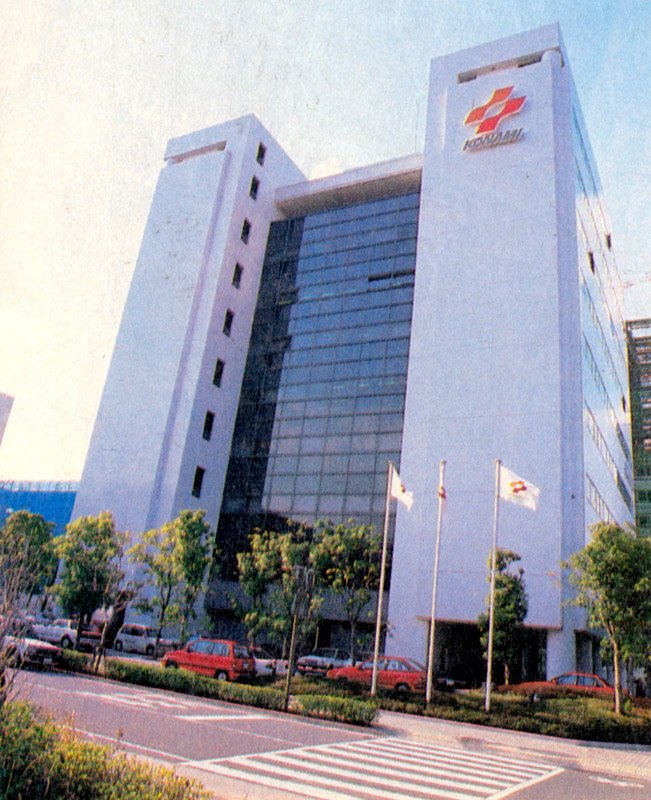
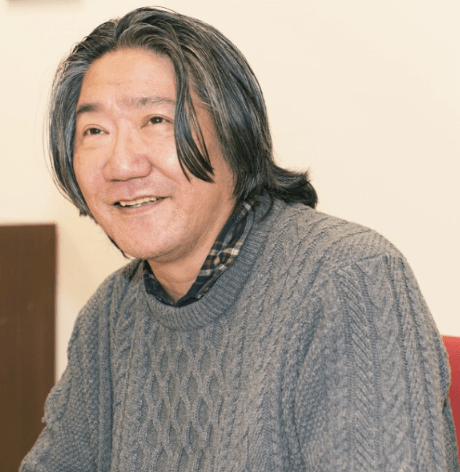
Nobuya Nakazato is a longtime Konami employee who is still working with the company to this day. Originally from Hachioji, Tokyo, Nobuya joined Konami in 1988 as a designer on several Famicom titles. His first credited work was as a bug checker for 1988’s The Adventures of Bayou Billy for the NES. In 1991 he made his directorial debut with Laser Invasion on the NES (also known as Gun Sight ガンサイト in Japan). Laser Invasion is an action game that has 3 alternating gameplay styles: piloting a Boeing AH-64 Apache, side scrolling rail shooter sequences, and a first-person exploration mode. The first-person sequences are very similar to the two pseudo-3D levels in the original Contra on the NES, or more accurately, like the ones in the original arcade Contra.
Overall, Laser Invasion is a pretty cool game with a lot of variety and a really awesome soundtrack. The music was composed by Shigeru Fukutake, who would go on to become the executive producer for the music for the original Silent Hill. His score has so much energy and is reminiscent of other Konami soundtracks at the time such as Jackal, Monsters in my Pocket & Teenage Mutant Ninja Turtles III – The Manhattan Project. If you ever get the chance, give Laser Invasion a try. It’s multiple play styles already shows Nakazato-San’s ambition for intense action & multiple styles of gameplay.
Shortly after Laser Invasion, Nakazato directed the outstanding Contra III: The Alien Wars, released in 1992 for the Super Nintendo and Super Famicom. Another game with multiple gameplay styles, Contra III pushed the series to extreme heights. Literally. With more action, explosions, bigger bosses and just more intense gameplay in general, The Alien Wars marked itself as a classic on the SNES (and my heart). Following the successful SNES title, Nakazato-san continued to push the Contra series even further with Contra Hard Corps, in 1994, for the Sega Genesis. This time, they went with even more hyper energy and speed, as well as some whacky elements, including a Castlevania inspired level.
Right off the bat, this game lets you know it’s going for a goofier approach. While The Alien Wars was heavily inspired by 80s action films and took a more serious tone, Hard Corps’s tone was closer to that of a Saturday Morning cartoon. Its soundtrack was made up of several Konami veterans, including Akira Yamaoka of Silent Hill fame & Michiru Yamane of Castlevania fame. Speaking of Castlevania, Nobuya would eventually go on to work on Castlevania: Symphony of the Night as one of the many designers for the PSX version.
While Nakazato-San was busy working as a designer on the role playing PS1 title, Vandal Hearts, Konami handed Contra over to the California based company, Appaloosa Interactive. The Bay Area based team, known for their work on the Ecco the Dolphin series, developed two Contra titles for the Sony console, Legacy of War & The Contra Adventure. Many agree these games did not live up to the standard set by the previous installments in the series. After these two less than stellar releases, Nakazato-San returned to the franchise to show them how to properly make a Contra game. Released in 2002, Contra: Shattered Soldier (Or Shin Contra in Japan) is a perfect return to form. As if Alien Wars & Hard Corps weren’t tough enough, Shattered Soldier certainly kicks your ass. Working as both Director & producer, Nakazato-San brought the franchise back to its roots with 2D gameplay & hard as fuck gameplay.
Like Hard Corps, there are multiple endings here. One of the new elements this game introduced was getting rid of power up items. Instead, your character has 3 pre-selected weapons which you can alternate between. Also new is the ranking system, with S being the highest. At the start of the game, there are only 4 selectable levels, afterwards, more are unlocked. Before moving onto stage 5, you are free to go back to any of the previous levels & try to get higher ranks.
Not only is the game difficulty brutal, but so is its presentation & design. The visuals can be grungy, with lots of rusted metal, dark corners and shades of greys, blue, and browns. Its aesthetic is very claustrophobic and grim. This is because the game’s background & enemy designers all just finished working on the masterpiece that is Silent Hill 2. Noriyoshi Sato, Takayuki Ando, Hitomi Namatame, and Atsushi Ono were in charge of designing the rooms, towns and models for Silent Hill 2 and they clearly brought their expertise in grim & depressing visuals to Contra, which I think works really well.
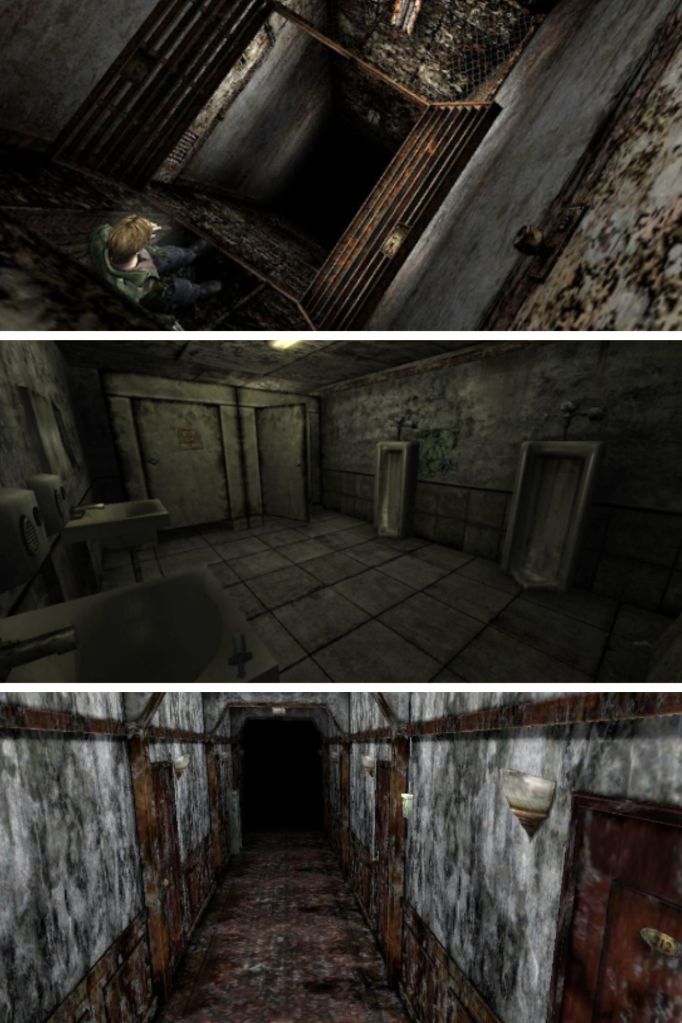
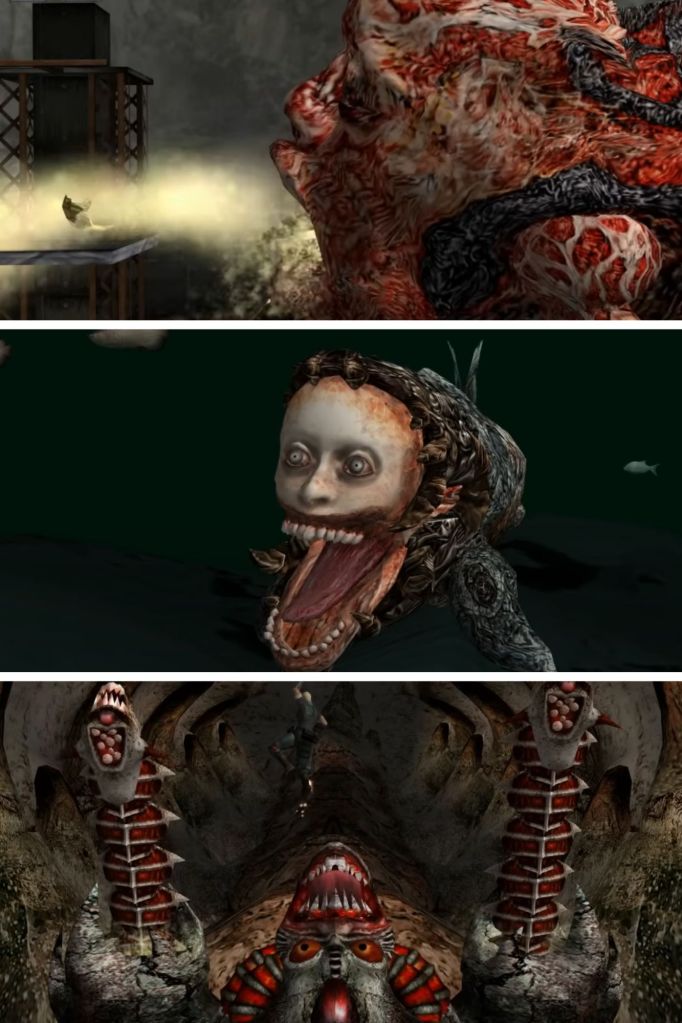
The bosses also exemplify the grim presentation with its horrific boss designs.
Not only does this game’s visuals parallel with Silent Hill, but so does its soundtrack, which was co-composed by Akira Yamaoka. Taking that gritty, crunchy energy from his song, Angel’s Thanatos, and unfolding it to its full potential with Shattered Soldier, Yamaoka-San delivered one gaming’s most hardcore soundtracks. My personal favorite tracks from him are RELIC OF MOIRAI, MAXIMUM SPEED & SUPER-POWERED ROBOT YOKOZUNA Jr, which is reminiscent of one of his tracks for Beatmania series, tant pis pour toi. While his compositions were more metal & industrial, the other half of the soundtrack was composed by Sota Fujimori. Coming from a more Trance inspired background, Fujimori-San contributes most of the electronic compositions. While I personally feel Akira’s songs match the essence of this particular game more, Sota’s songs give the game a good balance that still matches the brutal gameplay and hyper energy. His tracks such as JINMEN-GYO & BATTLE TRAIN are just phenomenal. Together, these two amazing musicians helped make this one hell of a game.
Not long after the release of Shattered Soldier (Shin Contra), most of the same team began working on the next entry in the Contra series, Neo Contra. Although this new game is a direct sequel, Nobuya Nakazato, now acting as producer, didn’t name it Shin Contra 2 because the gameplay was changing to something other than 2D. In an interview he did with 1UP.com in Janurary of 2004, Nakazato-san said Neo Contra is a completely new experience, while at the same time creating a game that would appeal to traditional fans.
In reference to one of the PS1 Contras, he stated “The PS1 game developed by Appaloosa was a great reference. The difficult thing about 3D action is that it’s very difficult to get a sense of the distance of the attack. Appaloosa’s work was difficult to understand the system, nor did it have a proper “offense” and “defense” system. With Neo Contra, I think we were able to achieve that brilliantly”. In the same interview, he was asked if he’d ever want to add stealth or RPG elements to the Contra series to keep up with the latest trends. Nakazato-San replied, “Fans who love and support Contra are looking for pure high-speed action. Contra should always be a “head-to-head” action, and we have no intention of turning it into an RPG or stealth action.”
Although this was the right mindset to keep a loyal fanbase happy, the fanbase, unfortunately, was just not that big. During this time, other franchises were dominating the gaming landscape. Series like Final Fantasy, Metal Gear Solid, Tekken & a plethora of others were making the rounds. RPGs in general were taking over the scene, with hardcore, arcade style games dwindling down. Because of this, Neo Contra came and went, without so much as a fanfare.
The game released in 2004 exclusively on the Playstation 2. It was strictly an overhead shooter, similar to Legacy of War or the overhead levels in The Alien Wars or Super. some of the mechanics from the previous title remained such as the weapon switching & ranking system. One of the biggest changes, however, was the lack of jumping. Instead, the player presses X to roll out of the way, very awkwardly I might add. Also new is the locking system which is used to attack airborne targets. Much like Hard Corps, Neo didn’t take itself too seriously. While Shattered Soldier looks like it basically takes place in a Silent Hill universe, this game is set in a goofy anime.
Akira Yamaoka did not return to compose for this one., due to his involvement with Silent Hill 3 & 4. Fujimori-San composed Neo Contra entirely by himself, delivering one of my all-time favorite soundtracks. I won’t talk about the music too much, as I’d like to eventually speak about Sota Fujimori more in depth in the future. My favorite tracks are Drum ‘n’ Boss, Heaven’s Beat, 101, Open Your Mind and the Battle Train remix (which is not on the official soundtrack release for some reason). This version of the song was even put into Beatmania IIDX 23: Copula. The music in Stage 4, which is a remix from the 1988 classic, Super C. You can clearly hear Sota’s love for the synthesizer all over this soundtrack. There are so many beautiful melodies, solos, sounds and vocal samples throughout. The music is just as electrifying as the game itself. Ship to Shore released an official vinyl soundtrack for Shattered Soldier. I really wish they would do the same for Neo Contra.
The presentation is not as dark as its predecessor, but I really love the overall visuals of this game. Many games around this time were using this futuristic aesthetic, which was comprised of cool blues, turquoise & teal backgrounds, lights, and grey walls. Visuals like these can be seen as dated now, but it’s a style I really like and sorely miss. It matched the electronic music that was found in most games of the period and it’s these kinds of environments that made me feel like I was transported to another world. It was exciting, fresh, and cool.
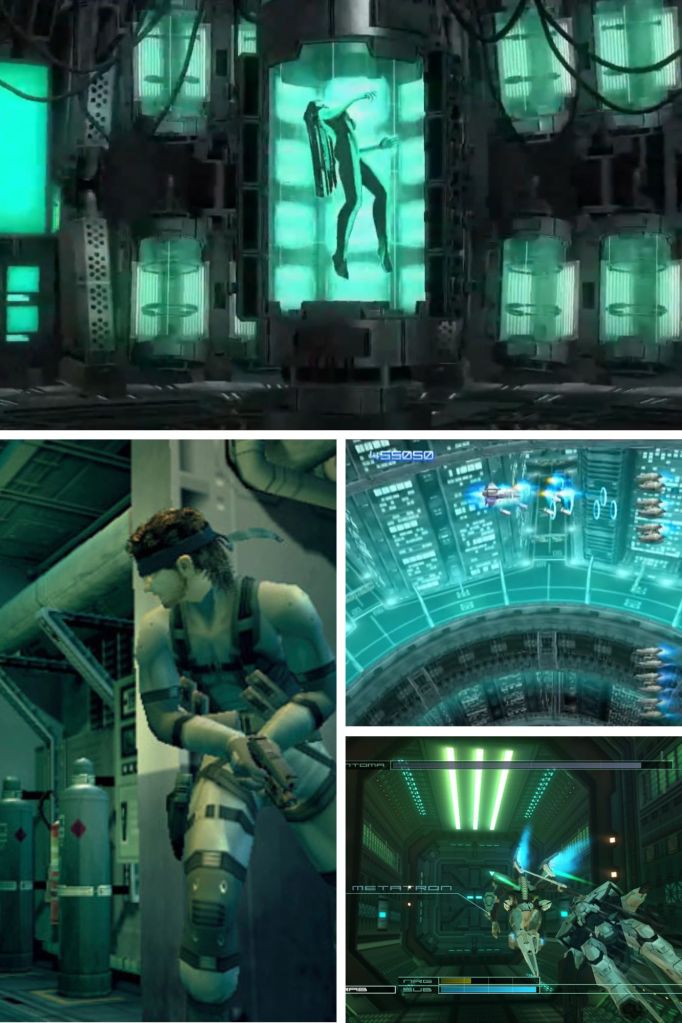
4 months before Konami released Neo Contra, they dropped another one of their masterpieces, Gradius V. Released on July 22, 2004, Gradius V was the final big hurrah for the Gradius series, much like how Neo Contra was for the Contra series. Gradius V is universally praised and is the perfect example of how to evolve a series forward, rather than changing things or taking things away. A really cool feature in Neo Contra is the ability to unlock Type F weapons, which are GV laser & Laser Ripple, both taken directly from Gradius V. Once you unlock these, the game becomes much easier, making speed running the game a lot more fun.
On the topic of Gradius, Neo Contra composer, Sota Fujimori has stated that the original 1985 Gradius is his favorite game and is what inspired him to become a composer. While I wish I could say it would have been amazing if he got to compose the soundtrack for Gradius V, the music done for that game is perfect enough already. Composed by the RPG music master, Hitoshi Sakimoto, the soundtrack for Gradius V is beyond phenomenal and remains one of my favorite soundtracks of all time. Sota did eventually get to make a Gradius Medley for Konami’s Beatmania series.
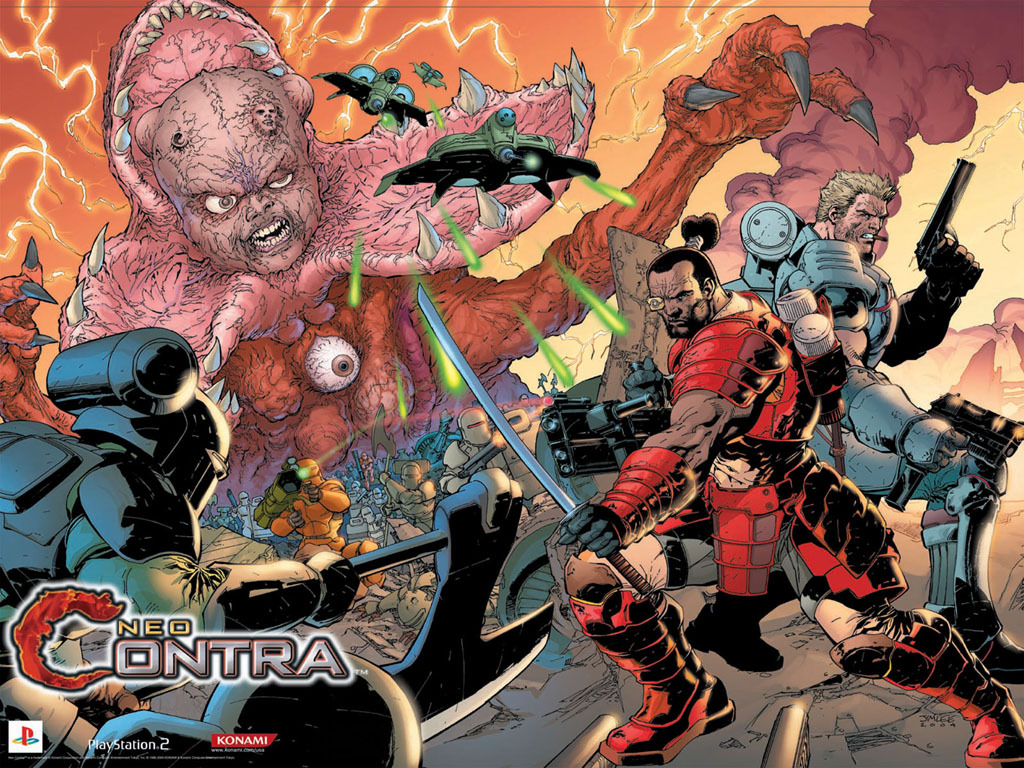
The packaging artwork for Neo Contra was done by the legendary DC artist, Jim Lee. Not sure how that happened but it’s pretty cool. You figured Konami would have used his talents for a bigger tittle for more exposure. I’d really like to ask Mr. Lee or Nobuya-San who’s decision it was to collaborate with him for this hardcore game that was doomed to fail.
After Neo Contra, Nobuya Nakazato would go on to work on other Konami titles throughout the years, working as the General Manager for Castlevania: The Dracula X Chronicles for the PSP, Producer for the Contra & Gradius ReBirth games on the Wii, and eventually producing the next installment in the Contra series, Contra: Rogue Corps, released in 2019. He had no involvement in the 2024 Contra: Operation Galuga, which is a great game by the way.
Generally speaking, I’m not here to review Neo Contra; its controls, positives & negatives. I just wanted to highlight one of my favorite games & soundtracks. It’s underrated but I understand why it’s underrated. Even if they port this, alongside Shattered Soldier, to modern consoles, I don’t believe it would sell well again or not many people would even give it a shot. Although it is not a particularly hard game, It’s too difficult for general audiences. On top of that, it’s a very short game, as a Contra game should be. I personally love shorter games. They give me a chance to revisit them more often. They also let me test myself by trying to master them and improve my skill with each playthrough. It’s a philosophy that dominated arcade style games back then and Neo Contra is one of the last big ones. Its failure to sell, along with the not so popular Gradius V, Zone of the Enders, F-Zero GX and many other short, difficult games, proved that the gaming scene had changed. It was no longer about getting high scores or ranks. It was about playing bigger, longer, more complex games. The need for “Pure High-Speed Action” had gone underground.
 Bloodstained Philosophy